The numbers of Canada geese on the marsh have continued to rise, now reaching about 135. Apparently the marsh has become a staging area for many family groups. They will rest here until the time comes for them to migrate. The top shot here shows about half of the flock. Sometimes they leave the marsh during the day to feed elsewhere, returning to the marsh for the night. The bottom shot, taken this morning, shows the two white geese that have joined the gathering, both with varying amounts of grey mixed with the white. They are definitely larger than their Canada cousins.
On Monday I was able to get close enough to get this shot of two of the hooded mergansers that are now on the marsh. I believe the lower bird is a female as it has a yellow bill (the first year males look much like the females, but have a darker bill). The upper bird is a male with its crest raised. They may remain until the marsh freezes, then move to the river.
For those of you who have been wondering if I've fallen off the face of the earth, I'm still here and still walking around the marsh every day. The reason there have been no postings of late is that I've had few sightings of anything close enough to get a good shot. Compared to last year, there seems to have been much less activity at the marsh. There are still ducks on the water - blacks, mallards, buffleheads, American wigeons, green-wing teals, even a few hooded mergansers - but for the most part, they stay quite a ways from shore. I have had one muskrat sighting since mid-summer. Even the chipmunks and red squirrels haven't been as plentiful as usual. I think some of the reason has to be because of the presence of the great horned owl family that nested near the marsh last winter and remained in the area until the end of the summer. I'm sure the wildlife at the marsh were easy pickings for these predators.
I will continue to walk the trail until it becomes impassable, but postings from now until spring will likely be intermittent. Until next time, here's a couple of shots I got recently. The one of the cedar waxwing was taken on Halloween, a lovely day that followed the nor'easter that blew through. The bottom shot was taken yesterday. There were two black ducks perched on the stick to the right when I approached, but when they saw me they jumped off into the water and swam away. I happened to get this shot just as the second one plopped into the water.


The buffleheads have returned to the marsh from their breeding grounds farther north. (I call them clowns because of their playful antics.) A few have been here for a couple of weeks, but were mainly on the sewage lagoon. I caught these two this morning on the marsh proper. Its difficult to tell if these two are adult females or first winter males, as the young ones of both sexes resemble adult females. They'll be seen bobbing around the marsh until it freezes over, at which time some may move to the river and remain through the winter while the remainder may move farther down the coast.

The geese are remaining on the marsh longer in the day now. I have only seen one of the white geese with the large flock these last few days. Doing some research on the presence of white geese with Canadas, and given the large size of the bird, I'm inclined to believe that it is a cross between a domestic goose and a Canada goose. Snow geese are generally smaller birds than the Canadas. This shot was taken on Tuesday of this week.

I got to the marsh Friday morning before the Canada geese had left for the river. I was surprised at the explosion of numbers - I counted 105 birds (a week ago there were between 50 & 60). What I was also surprised by was the presence of two white geese among the pack (one shown here). Since they were far out on the water, I couldn't get a clear shot, but it looks like the white birds may be snow geese.

When I saw these birds flying over the marsh last Friday, I assumed they were the Canada geese that spend nights on the marsh and fly out to the river come morning. However, I thought it rather odd that they weren't making any noise. When I zoomed in, I discovered they were cormorants. What I may have witnessed was a migratory flight, as apparently October and November are the peak migration times for northern cormorants.

I didn't know until today that the American black duck population is declining, due to pressure from the ubiquitous mallard - through interbreeding and displacement from preferred breeding habitat. The black duck population at the marsh appears to my eyes to be relatively consistent, but there does seem to be a growing number of mallards present. This shot shows some of the mallards I saw this morning.

Until yesterday, I hadn't seen any of the wood ducks for a couple of weeks. I even checked the sewage lagoon where a pair remained into November last year. But yesterday I got a glimpse of at least one drake, and this morning I spied several of the ducks, including these two males. They are now in their full breeding plumage, and present the sleek appearance that we associate with these birds.
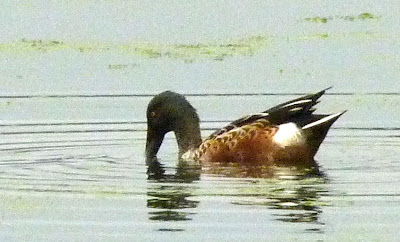
This northern shoveler drake was feeding by himself at the marsh this morning. He still hasn't achieved his full breeding plumage. I expect he will be leaving for his wintering grounds any day now.


