
This young male American black duck happened to be feeding close to the water's edge this morning, so I got off a few quick shots before he swam away.

This shot of a young American black duck, which was feeding in the duckweed until I disturbed it, gives a good indication of the molting that is presently taking place among the waterfowl, what with all the feathers caught in the duckweed.

This is one of several black duck families at the marsh. Yesterday I saw a black duck with two very young chicks, probably a younger female, who usually breed later and have fewer offspring. Two of the young in this group seem to be larger than the others for some reason.

This female black duck and her eleven offspring (not all shown here) were engrossed in feeding when I walked the trail this afternoon. Various pond weeds make up the major part of their diet, particularly in the summer months.

As I was heading towards the viewing stand by the railbed this morning, I caught sight of one of the black duck families close to shore. I moved quickly to see if I could get a shot of them, and obviously caused them to move just as quickly - away from me! This is the female with the eight young shown in yesterday's posting.


I walked the trail last evening, and happened on the new black duck family shown at the top, with eight young. Doesn't 'mom' look proud of her flock?? This morning I found a second black duck family, with twelve ducklings, all but one of which are shown in the bottom shot. Their mother was at the right, just out of the frame. The two wood duck families were out and about this morning as well.

More black ducks. I could hear a duck commotion as I was walking the trail this morning, and when I came to the spot, I saw a group of 16 black ducks (ten shown here), apparently all drakes, milling about, swimming a few feet in one direction, turning and swimming a few feet in the opposite direction, back and forth, back and forth - why they were doing what they were doing is a puzzle to me!

These are the same two black ducks I spotlighted on the 21st - at least I presume they are the same two since they were at the same spot. I discovered they are not a pair, but two drakes, given they both have yellow bills. That probably means their mates are already nesting somewhere, since apparently black ducks begin nesting shortly after arrival. These two were busy preening when I saw them this morning. I wanted to include this shot since both are showing a distinctive feature of the black duck, their purple speculums, or upper wing patches.

The American Black Ducks are the most numerous of the dabbling ducks at the marsh. Since they are so common, they can easily be taken for granted, so I thought I'd give them a little exposure (pun intended). There's at least one thing that makes this duck stand out - its the 'quack' of the hen of this species that has become the standard sound of a duck. Not all ducks quack! Even the male black duck just makes a croaking sound.
This pair was resting when I caught them this morning, although the drake (yellow bill) lifted his head as I approached.

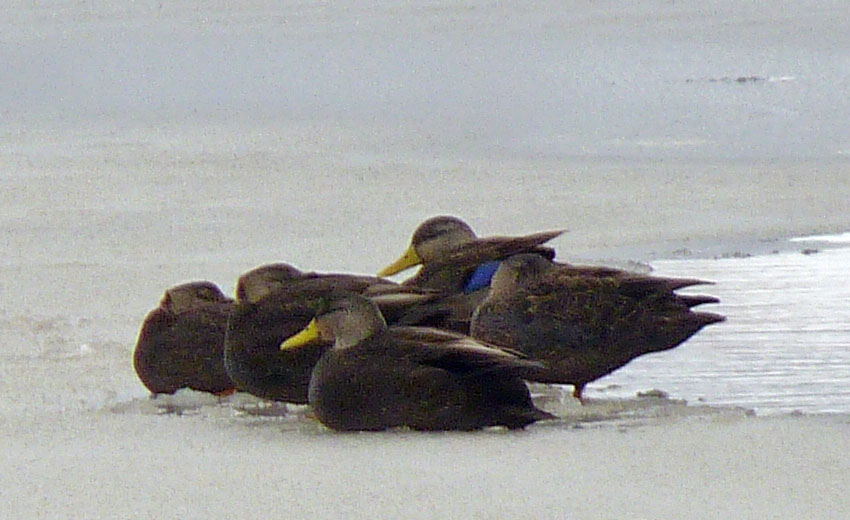
Not many sightings of creatures in the flesh on my walk this morning. These Black Ducks were huddled together on the ice at the sail centre cove. Since these ducks are dabblers rather than divers like the buffleheads and the mergansers that remain here over the winter, they have to find shallower spots to feed.

There was the usual contingent of Black Ducks in the open water at the rail bed end of the marsh. Being 'dabblers' they feed by tipping over, as you see by the 'bottoms up' position of this group. The ice is visible across the lower edge of the shot.

November's fickle weather dished up snow flurries today, so I enclosed my camera in a plastic bag when I made my daily trek to the marsh. I noticed a variety of ducks here and there - the usual buffleheads, some ring-necked ducks, 15 hooded mergansers, and about a dozen American Black Ducks, including these two males, seemingly unperturbed by the snow.

Three Black Ducks had found a narrow strip of open water in the ice at the marsh this morning, two of which are shown here (watercolor filter applied). I checked the sewage lagoon to see what might be present there - about 30 black ducks took to the air when I got close. There were also a number of bufflehead ducks swimming about on the lagoon. In the inlet to the French Basin I spied one lone American coot.

I only got a little wet this morning when I made my (almost) daily visit to the marsh. These two juvenile American Black Ducks were feeding at the water's edge as I approached - and surprisingly did not swim away, as is their usual response.
There is still a significant number of ducks on the marsh. When I stood on the viewing stand later and scanned the marsh with my binoculars, I could make out over 300. And that's just the ones I could see.
.jpg)
I've been seeing a pair of Black Ducks feeding at the edge of the marsh the last several days. When I come along they move out into the water. This morning I was dismayed to find the body of one floating, belly up, at the marsh's edge, close to where I've been seeing them. A little farther on, I came across this female, perhaps the companion of the dead one. I was surprised to see the carcass, as I would think that if it were killed by a fox or other predator, it would have been devoured or carried off.

It started to rain when I was about half-way around the marsh this morning, so I tucked my camera in a plastic bag I always carry just in case, and headed home. Then I noticed this Black Duck lying on a clump of grass, and thought - the perfect shot for illustrating 'like water off a duck's back' - !. So I poked a little hole in the plastic bag to look through the viewfinder, opened the end of the bag that covered the lens, and depressed the shutter button through the bag. Viola!

I found a number of the Black Ducks resting out of the wind on cattail clumps, including this Black Duck with head well tucked into its feathers.

In the cattails near the viewing stand, where the Red-winged Blackbirds nest in the spring, I have noticed ducks lying in what little space they could find. Over the years, the 'loafing bars' that were left for the birds to rest on when this marsh was created, have worn away completely or down to almost nothing. Especially with this summer's high water level, resting spots have become a premium. This morning, I found this Black Duck sleeping in an awkward position on a cattail clump.

You may recall that I said that watching dabbling ducks feed off the bottom sometimes reminds me of water ballet. That's exactly what I was thinking this morning while I watched a group of juvenile Black Ducks 'perform'. I especially liked this move. Well synchronized, I thought.




.jpg)


